Category: Chess

A Seventeen-Year-Old Young Man

A Seventeen-Year-Old Young Man

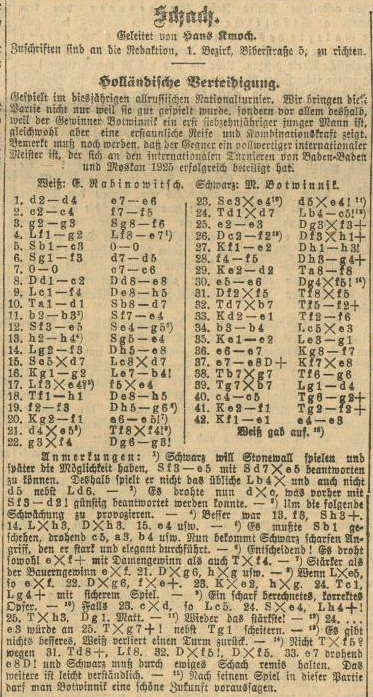
From Hans Kmoch’s column in Neues Wiener Journal, November 12, 1927.

Played in this years All-Russian national tournament. We show this game not only because it is well played, but mainly because the winner, Botvinnik, despite being a just seventeen-year-old young man, shows remarkable maturity and tactical power.

It should be noted that his opponent is a fully fledged international master, who successfully participated in the international tournaments of Baden-Baden and Moscow 1925.

I. Rabinovich – M. Botvinnik
1. d4 e6 2. c4 f5 3. g3 Nf6 4. Bg2 Be7
Black wants to play the Stonewall and to later have the possibility of answering Ne5 with Nxe5. Therefore he doesn’t play the usual Bb4+ and also not d5 followed by Bd6.
5. Nc3 O-O 6. Nf3 d5 7. O-O c6 8. Qc2 Qe8 9. Bf4 Qh5 10. Rad1 Nbd7 11. b3
Now dxc4 was threatened. It could previously be advantageously answered by Nd2!
11… Ne4 12. Ne5 Ng5
To provoke the following weakness.
13. h4
Better was 13. f3 Nh3+ 14. Bxh3 Qxh3 15. e4 etc.
13… Ne4 14. Bf3 Qe8 15. Nxd7 Bxd7 16. Kg2 Bb4! 17. Bxe4?
17. Nb1, threatening c5, a3, b4 etc., had to be played. Now black gets a sharp attack, which he executes strongly and elegantly.
17… fxe4 18. Rh1 Qh5 19. f3 Qg6
Decisive! Threatening both exf3+ winning the queen, and also Rxf4.
20. Kf1 e5!
Stronger than winning a pawn with 20… exf3 21. Qxg6 hxg6.
21. dxe5
If 21. Bxe5 exf3 22. Qxg6 fxe2+ 23. Kxe2 hxg6 24. Rc1 Bg4+ with a safe game.

Pos6

21… Rxf4!
A sharply calculated and correct sacrifice.
22. gxf4 Qg3! 23. Nxe4
If 23. cxd5 Bc5 24. Nxe4 Bh3+! 25. Rxh3 Qg1 mate.
23… dxe4!
Again the strongest!
24. Rxd7 Bc5!
24… e3 would fail to 25. Rxg7+! followed by Rg1.
25. e3 Qxf3+ 26. Qf2
There is nothing better. White loses a rook back.
26… Qxh1+ 27. Ke2 Qh3! 28. f5 Qg4+ 29. Kd2 Rf8 30. e6 Qxf5!
Not 30… Rxf5? because of 31. Rd8+ Bf8 32. Qxf5! Qxf5 33. e7 threatening e8Q! and black has to draw by perpetual check. The rest is easily understood.
31. Qxf5 Rxf5 32. Rxb7 Rf2+ 33. Ke1 Rf6 34. b4 Bxe3 35. Ke2 Bg1 36. e7 Kf7 37. e8=Q+ Kxe8 38. Rxg7 Rg6 39. Rxh7 Bd4 40. c5 Rg2+ 41. Kf1 Rf2+ 42. Ke1 e3 White resigned.
After his play in this game one must dare to predict a wonderful future for Botvinnik.

Source: ANNO

Chess Board Cake

Chess Board Cake

  1. Cream together ½ lb of butter and ½ lb of sugar
  2. Add 5 eggs (one at a time)
  3. Add 10 oz flour
  4. Add 1 teaspoonful of baking powder
  5. Colour one-half with 1 tablespoonful of cocoa (or it may be coloured pink)
  6. Put each half in a greased divided tin, and bake about half an hour in moderate oven
  7. When cold cut each cake into four strips, put four pieces together with jam, colours alternately
  8. Roll out a piece of cocoa nut, paste, paint over with egg, lay cake bar on, and wrap completely round cake

From The Brisbane Daily Mail, July 9, 1922.

Lasker’s forgotten games from Montreal 1892

Lasker’s forgotten games from Montreal 1892

Emanuel Lasker visited Montreal in November 1892, gave two simultaneous exhibitions and played a number of single games against the best local players. Ken Whyld (‘The Collected Games of Emanuel Lasker’) gives 8 games, most of them from Joseph Ney Babson’s chess column in The Montreal Daily Herald.

John Henderson’s column in The Montreal Gazette has a further 7 games.

Here are all the games:

November 21, simultaneous exhibition

(Not November 22, as Whyld claims.) Lasker played 24 opponents, won 21 games, drew 2, and lost 1.

Emanuel Lasker – D. C. Robertson
1. e4 e5 2. Nf3 Nc6 3. Bc4 Nf6 4. O-O Be7 5. d4 exd4 6. e5 Ne4 7. Bd5 Nc5 8. Re1 O-O 9. Nxd4 Nxd4 10. Qxd4 Ne6 11. Qg4 d6 12. Bh6 Bg5 13. Bxg5 Nxg5 14. Qg3 dxe5 15. Nc3 Ne6 16. Rxe5 c6 17. Bb3 Nd4 18. Rd1 b6 19. Nd5 Ne6 20. Ne3 Qf6 21. Nf5 Kh8 22. f4 Rd8 23. Rxd8+ Qxd8 24. Bxe6 g6 25. Bxf7 Qd1+ 26. Re1 resigns
The Montreal Gazette, November 22, 1892
The Montreal Daily Herald, November 22, 1892
Whyld, game 166

Emanuel Lasker – H. Bertrand
1. e4 e5 2. f4 exf4 3. Bc4 Qh4+ 4. Kf1 g5 5. Nf3 Qh5 6. h4 g4 7. Ng5 Nh6 8. Nc3 f6 9. Nd5 Qg6 10. d3 Bd6 11. Bxf4 Bxf4 12. Nxf4 Qg7 13. Nf3 gxf3 14. Qxf3 Rf8
Whyld gives no further moves and says, “Lasker resigned on [the] 31st move”
15. Nd5 d6 16. Ke1 Bg4 17. Qe3 c6 18. Nf4 Qe7 19. b4 d5 20. Bxd5 Nf5 21. Qd2 cxd5 22. Nxd5 Qe5 23. c3 Nc6 24. Kf2 Nce7 25. Nf4 Nd6 26. Rhe1 O-O-O 27. g3 Nxe4+ 28. Rxe4 Qxe4 29. Kg1 Qf3 30. Kh2 Nf5 31. resigns
The Montreal Gazette, December 3, 1892
Whyld, game 168

Emanuel Lasker – Putnam
1. e4 e5 2. Nf3 Nc6 3. Bb5 d6 4. d4 exd4 5. Nxd4 Bd7 6. Nc3 Nge7 7. Bg5 Nxd4 8. Qxd4 Bxb5 9. Nxb5 a6 10. Nc3 c5 11. Qd3 h6 12. Bh4 f6 13. O-O-O Ng6 14. Bg3 Ne5 15. Bxe5 fxe5 16. Qh3 Qd7 17. Qg3 O-O-O 18. Nd5 Qf7 19. a4 g5 20. a5 Rg8 21. Nb6+ Kb8 22. Qxe5 dxe5 23. Rxd8+ Kc7 24. Rc8+ Kd6 25. Rd1+ Ke6 26. Rdd8 Qf4+ 27. Kb1 Qxf2 28. Re8+ Kf7 29. Nd7 Qe1+ 30. Ka2 Qxa5+ 31. Kb1 Qe1+ 32. Ka2 1/2-1/2
The Montreal Gazette, November 23, 1892

Emanuel Lasker – J. Pelletier
1. e4 e5 2. f4 d5 3. exd5 e4 4. Nc3 Nf6 5. Bb5+ Bd7 6. Bxd7+ Nbxd7 7. d3 Bb4 8. Nge2 Nxd5 9. dxe4 Nxc3 10. bxc3 Bc5 11. Qd3 O-O 12. Be3 Qe7 13. O-O Rad8 14. Bd4 Bxd4+ 15. Nxd4 Nc5 16. Qh3 Qxe4 17. Rae1 Qd5 18. f5 Rfe8 19. f6 Rxe1 20. Rxe1 Ne4 21. fxg7 Nxc3 22. Nf5 Qc5+ 23. Kh1 Ne4 24. Nh6+ Kxg7 25. Qg4+ Kxh6 26. Rxe4 Qh5 27. Qf4+ Qg5 28. Qf1 Qd2 29. Qf6+ resigns
The Montreal Gazette, November 24, 1892

Emanuel Lasker – Palmerston Barry
Notes by John Henderson
1. e4 e5 2. f4 Bc5 3. Nf3 d6 4. d4
Seldom played.
4… exd4 5. Bd3
If White now plays 5. Nxd4, Black can play with advantage Nf6
5… Nc6 6. a3 a6 7. b4 Ba7 8. O-O Nge7 9. Kh1 O-O 10. f5 f6 11. Bc4+ Kh8 12. Nh4 Qe8 13. Nd2 Ne5 14. Bb3 c6 15. Bb2 d5 16. exd5 Nxd5 17. Bxd5 cxd5 18. Ndf3 d3
With the object of winning the exchange.
19. cxd3 Ng4 20. Qd2 Qe3 21. Rae1 Qxd2 22. Nxd2 Nf2+ 23. Rxf2 Bxf2 24. Re7 Bxh4 25. Nf3 Bf2 26. g4 d4 27. Nxd4 Bxd4 28. Bxd4 h6 29. h3 Kg8 30. Kg2 Rf7
We should prefer 30… b5 so as to liberate the pieces on the Queen’s side.
31. Re8+ Kh7 32. Bb6 Rd7 33. d4 Rd6 34. Bc5 b6 35. Rxc8! Rxc8 36. Bxd6 Kg8 1/2-1/2
Mr. Lasker offered a draw which was accepted. We believe Black should win by correct play, but the least slip against such an antagonist would be fatal.
The Montreal Gazette, December 10, 1892

Emanuel Lasker – Liddell
1. e4 e5 2. Nf3 Nc6 3. Bc4 Bc5 4. b4 Bxb4 5. c3 Be7 6. d4 d6 7. Qb3 Na5 8. Bxf7+ Kf8 9. Qa4 Kxf7 10. Qxa5 c6 11. Qa4 b5 12. Qc2 Bf6 13. Ba3 Nh6 14. Nbd2 a5 15. O-O Re8 16. Rad1 exd4 17. cxd4 b4 18. Bb2 Bd7 19. e5 Be7 20. exd6 Bxd6 21. Ne5+ Bxe5 22. dxe5 Kg8 23. Ne4 Qc7 24. Qd2 Be6 25. Nf6+ gxf6 26. Qxh6 Qg7 27. Qxg7+ Kxg7 28. exf6+ Kg8 29. Rfe1 Bd5 30. f4 Rxe1+ 31. Rxe1 Bxa2 32. Re7 Bf7 33. g4 c5 34. g5 Re8 35. Rc7 c4 36. Bd4 c3 37. f5 Re4 38. g6 hxg6 39. fxg6 Rg4+ 40. Kf2 Rxg6 41. Rc8+ Kh7 42. Rf8 Bg8 43. f7 c2 44. Rc8 Bxf7 45. Rh8#
The Montreal Gazette, December 24, 1892

November 22, single games

Emanuel Lasker – Joseph Peter Cooke
1. e4 e5 2. Nf3 Nc6 3. Bb5 Bc5 4. c3 d6 5. d4 exd4 6. cxd4 Bb4+ 7. Kf1 a6 8. Bxc6+ bxc6 9. Qa4 a5 10. a3 Ba6+ 11. Kg1 Bb5 12. Qc2 c5 13. axb4 cxb4 14. h3 Ne7 15. Be3 O-O 16. Nbd2 Qd7 17. Kh2 f5 18. exf5 Nxf5 19. Rhe1 h6 20. Rac1 c6 21. Ne4 Rae8 22. Ng3 Ne7 23. Nh4 Rf6 24. Nh5 Rf7 25. Ng6 Nd5 26. Nhf4 Nc7 27. Bd2 Rxe1 28. Rxe1 Qf5 29. Ne7+ resigns
The Montreal Gazette, November 23, 1892
The Montreal Daily Herald, November 23, 1892
Whyld, game 167

Joseph Ney Babson – Emanuel Lasker
Notes by Joseph Ney Babson
1. e4 e5 2. f4 d5 3. Nf3 Bg4 4. Nc3 Nf6 5. h3 Be6 6. f5 Bc8 7. d3 h6 8. Nxe5 Bd6 9. Bf4 O-O 10. Qf3 Re8 11. Ng4 dxe4 12. Nxf6+ Qxf6 13. dxe4 Bxf4 14. Qxf4 Qxf5 15. Qxc7 Qg5 16. Kf2
At this stage of the game Mr. Babson varied from the line of play he was contemplating and of course got into immediate difficulties, but at the close of the game Herr Lasker remarked that had White played 16. Bc4 the utmost that black could have hoped for would have been a draw. White considered this move for some time and would probably have made it against a less celebrated player than Herr Lasker, but the threatened check at h4 coupled with the sacrifice of the exchange and driving the white king out into the open field was quite enough to cause the cold chills to creep down his back and he didn’t make it.
16… Nc6 17. Bd3 Ne5 18. Raf1 Be6 19. Be2 Qf4+ 20. resigns
The Montreal Daily Herald, December 3, 1892
Whyld, game 169

Robert Short – Emanuel Lasker
1. e4 e5 2. Nf3 Nc6 3. Bb5 a6 4. Ba4 b5 5. Bb3 Nf6 6. Ng5 d5 7. exd5 Nd4 8. d6 Nxb3 9. dxc7 Qxc7 10. axb3 h6 11. Nf3 e4 12. Nd4 Bc5 13. Ne2 Ng4 14. d4 exd3 15. Qxd3 Nxf2 16. Qf3 Bb7 17. Bf4 Bxf3 18. Bxc7 Bxe2 19. Kxe2 Nxh1 20. b4 Bxb4 21. Nc3 Bxc3 22. bxc3 Kd7 23. Bb6 Rhe8+ 24. Kf3 Kc6 25. Bd4 f6 26. Rxh1 a5 27. Ra1 Kd5 28. Bb6 a4 29. Rd1+ Kc4 30. Rd7 a3 31. Rd1 a2 32. Ra1 Kxc3 33. resigns
The Montreal Gazette, November 23, 1892

Emanuel Lasker – D. C. Robertson
1. e4 e5 2. f4 d5 3. exd5 e4 4. Bb5+ c6 5. dxc6 bxc6 6. Bc4 Nf6 7. d4 exd3 8. Qxd3 Qc7 9. Nf3 Be7 10. O-O O-O 11. Nc3 Nbd7 12. h3 Nc5 13. Qe2 Bd6 14. Ne5 Be6 15. Bxe6 Nxe6 16. Nd3 Rfe8 17. Qf2 Rad8 18. Be3 Rd7 19. Rae1 Rde7 20. Bc1 Nc5 21. Rxe7 Qxe7 22. Re1 Nxd3 23. Rxe7 Nxf2 24. Rxe8+ Nxe8 25. Kxf2 Nf6 26. Kf3 Kf8 27. Ne4 Ne8 28. Be3 Ke7 29. Bxa7 Kd7 30. Bc5 Bxc5 31. Nxc5+ Kc7 32. a4 Nd6 33. a5 Nc4 34. b4 Na3 35. c3 Nb5 36. Na4 “After a few more moves Mr. Robertson lost the game.”
The Montreal Gazette, November 23, 1892

November 23, consultation game

Emanuel Lasker/Marler/Liddel – Joseph Ney Babson/John Henderson/Richard F. Flemming
Notes by Emanuel Lasker and Joseph Ney Babson
1. e4 e5 2. Nf3 Nc6 3. Bb5 d6 4. d4
Lasker: This is the strongest available move for white in this variation of the Ruy Lopez.
4… exd4 5. Nxd4 Bd7 6. Nc3 g6 7. Be3 Bg7 8. Be2
Lasker: To support an eventual attack with g4, but also otherwise a good move.
8… Nf6 9. Qd2 h6 10. f3 a6
Lasker: Waiting for white to castle.
Babson: At this point the Black Allies were somewhat in doubt as to what white intended to do next and thought they would wait and see.
11. Rb1
Lasker: Forcing black to activity.
Babson: They found out.
11… Qe7 12. b4 Nxd4 13. Bxd4 O-O 14. O-O Rfe8 15. Rbd1 Bc6 16. Bc4
Lasker: White has now a superior game.
Babson: The gentlemen in the little side room anticipated this superior move, and dreaded it, but there didn’t seem to be any good way to prevent it.
16… Nh7 17. Be3
Lasker: Another good movement of the white allies.
Babson: A good move, threatening to win a pawn, and Black’s reply doesn’t help matter in the least, for White’s next move makes assurance doubly sure.
17… Qe5 18. Nd5
Lasker: Winning at least a pawn.
18… Bxd5 19. Bxd5 c6 20. Bb3
Babson: As snug as a bug in a rug.
20… Qh5
Lasker: If 20… d5 instead, white answers with 21. Bf4 with a winning attack.
Babson: At this point the Black Allies called for coffee and didn’t duly consider this move, or they would probably have seen some of its dire effects, but they had tumbled to the racket before White sent in the crushing rejoinder. Alas! it was too late then.
21. g4 Qh3 22. Qxd6 Be5 23. Qxg6+ Kh8 24. Qxh6 Bxh2+ 25. Kh1 Qxh6 26. Bxh6 Be5 27. Rd7 Red8 28. Rfd1 resigns
The Montreal Gazette, November 24, 1892 & November 29, 1892
The Montreal Daily Herald, November 24, 1892 & December 3, 1892
Whyld, game 170

November 24, simultaneous exhibition

Lasker played 26 opponents, won 24 games, drew 1, and lost 1.

Emanuel Lasker – Joseph Ney Babson
1. e4 e5 2. Nf3 Nc6 3. Bc4 Bc5 4. b4 Bxb4 5. c3 Ba5 6. O-O d6 7. d4 exd4 8. cxd4 Bg4 9. Bb2 Bb6 10. Bb5 Bd7 11. d5 Ne5 12. Bxd7+ Qxd7 13. Bxe5 dxe5 14. Nxe5 Qb5 15. Nc3 Qb4 16. Qg4 Qe7 17. Qxg7 Qf6 18. Qxf6 Nxf6 19. Nf3 Ba5 20. Rac1 O-O 21. Nd2 Rfe8 22. h3 Nd7 23. Nc4 Bb4 24. Nb5 Rec8 25. g3 a6 26. Nc3 Bc5 27. Kg2 b5 28. Na5 Bb6 29. Nc6 Kf8 30. Ne2 f6 31. Nf4 Kf7 32. Ne6 Ne5 33. Nxe5+ fxe5 34. f4 Kf6 35. Rce1 c5 36. fxe5+ Kxe5 37. Rf5+ Kd6 38. Rd1 c4 39. e5+ Ke7 40. Rdf1 Bc5 41. Rf7+ Ke8 42. d6 resigns
The Montreal Gazette, November 25, 1892
The Montreal Daily Herald, November 25, 1892
Whyld, game 171

Emanuel Lasker – J. D. Cameron
1. e4 e5 2. f4 exf4 3. Nf3 Be7 4. Bc4 Bh4+ 5. Kf1 d6 6. d4 Nc6 7. Bxf4 Bf6 8. Nc3 Nh6 9. e5 Be7 10. Bxh6 gxh6 11. Bxf7+ Kxf7 12. d5 Nxe5 13. Nxe5+ dxe5 14. Qh5+ Kg7 15. Ke2 Bd6 16. Raf1 Rf8 17. Rxf8 Qxf8 18. Rf1 Qe7 19. Ne4 Bd7 20. Rf6 Rf8 21. Qxh6+ Kh8 22. c4 Qg7 23. Nxd6 Qxf6 24. Qxf6+ Rxf6 25. Nxb7 Rb6 26. Nc5 Bg4+ 27. Ke3 Rxb2 28. h3 Bc8 29. Ke4 Re2+ 30. Kf3 Rxa2 31. g4 Rc2 32. Ke4 Rxc4+ 33. resigns
The Montreal Gazette, November 25, 1892
The Montreal Daily Herald, November 25, 1892
Whyld, game 172

Emanuel Lasker – Robert Short
Notes by John Henderson
1. e4 c5 2. Nf3 Nc6 3. d4 cxd4 4. Nxd4 g6
This style of defence is often adopted since it’s introduction, at Frankfurt, by L. Paulsen.
5. Be3 Bg7 6. Nc3 Nf6 7. Be2 d6 8. Qd2 Bd7 9. h4 Ne5 10. h5 Neg4 11. Bg5 Nxh5 12. Ndb5 Nhf6 13. Bxg4 Bxg4 14. Bxf6 Bxf6 15. Nd5 Kf8 16. Nxf6 exf6
After the exchanges White remains with the superior game.
17. f3 Be6 18. O-O-O a6 19. Nxd6 Qe7 20. g4 g5 21. Qb4 Rd8
Immediately fatal.
22. Nf5
Beautiful finish! Of course if Black takes the Queen he is mated on the move, and he must lose his Queen by any other line of play at his disposal.
22… Rxd1+ 23. Rxd1 resigns
The Montreal Gazette, December 10, 1892
Whyld, game 173

Emanuel Lasker – D. C. Robertson
1. e4 e5 2. Nf3 Nc6 3. Bb5 Nf6 4. d4 exd4 5. e5 Ne4 6. O-O a6 7. Ba4 Nc5 8. Bxc6 dxc6 9. Qxd4 Qxd4 10. Nxd4 Be7 11. Nc3 O-O 12. Be3 Bd7 13. Rad1 Rad8 14. Rd2 Bc8 15. Rfd1 h6 16. Nxc6 bxc6 17. Rxd8 Rxd8 18. Rxd8+ Bxd8 19. Bxc5 Bf5 20. Ne2 Bxc2 21. Nd4 Be4 22. f3 Bd5 23. b3 Bg5 24. Nf5 Bf4 25. Bd4 g6 26. Ng3 Kf8 27. Ne2 Bd2 28. Kf2 Ke8 29. Be3 Bb4 30. Bxh6 c5 31. Ke3 c4 32. bxc4 Bxc4 33. Nc1 Ba3 34. Kd4 Bxc1 35. Bxc1 Bxa2 36. Kc5 Kd7 37. Bb2 1/2-1/2
The Montreal Gazette, December 25, 1892
Reshevsky analyzed

Reshevsky analyzed

From The Los Angeles Evening Herald, June 28, 1921:

9-YEAR-OLD CHESS MARVEL ANALYZED BY NOTED
PSYCHOLOGIST

Herbert Lapham, character analyst and psychological expert, last night watched the child wonder of the age play against men old enough to be his grandfather and defeat them, and this is what he has to say of the infant prodigy:

Herbert Lapham

Samuel Rzeschewiski [sic] is a boy not so different from other normal boys, either in size or physical makeup. He is quite small and has a head slightly above the average for his age, but not excessively so. He is well balanced all around but of a distinctly mental type with a fairly active body and well developed normally if not overly crowded in his studies or too much confined. He has some of the characteristics which seem to inevitably mark the youngest child in a family of four or more where the parents are of mature age at the time of the last child’s birth in that he is quite serious — too much so for his ultimate good. Then, too, he has not a strong physique.

NATURAL RESULT
This is a natural pre-natal result where the parents are harmonious and mental tendencies of middle life are in ascendancy over the physical. All parents have the opportunity to produce highly mental children at middle age if they prepare for it. Sammy is mild, non-aggressive, kindly disposed towards all people and things, even tempered and wholly amenable to influence and control except where his ideals and personal rights are concerned. He is strongly individual, has the possibility of developing a firm will, and will be fairly ambitious but never selfishly nor obtrusively so.

This boy should be called a young man because his co-efficient of intelligence is equal to or greater than that of the average boy. He has one remarkable development, that of intellectual reasoning and concentrating ability, coupled with a strong intuitive faculty. First of all he has a “hunch” as to the best thing for him to do in all affairs, and his association with people who are engaged in concentrated mental effort — as in chess — has brought out that sense of “knowing” without having to figure it out. Psychologists call this a more or less direct contact with the subconscious mind. If this boy had greater imaginative visualizing ability he would be hailed as a clairvoyant instead of a chess player.

His decisively predominant reasoning power protects him from straying off into psychic realms for he is logical and efficient in his processes of thought. He is of the type of personality which prefers things useful and workable rather than fanciful and impractical.

SENSITIVE TO CRITICISM
Sammy is very sensitive to criticism or any adversity of life or surroundings. He is of that type of children who should never be corrected. In the first place, he has a keen sense of justice and what is right, a loving and responsive feeling toward all, birds, flowers and kindly people, a tendency to reason analytically, synthetically, deductively and inductively to a judgment which is nearer the truth than that of a very large number of his elders. His mistakes would be only those of a clear-seeing mind meeting up with conditions of life imposed by a not overly developed civilization. This is particularly true because of his idealistic and impersonal tendencies.

If he is not foolishly overcrowded in his studies, is not forced to expend his mental abilities uselessly, and allowed entire freedom in his choice of pursuits, he will be heard from in literary, inventive and general creative lines of a highly scientific nature, wherein the benefit of mankind in general is the moving spirit.

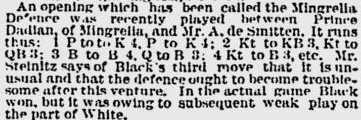
The Mingrelia Defence

The Mingrelia Defence

The Mingrelia Defence
Newark Sunday Call, July 2, 1893

From Steinitz’ chess column in New York Daily Tribune, June 18, 1893:
A stoutly contested and elegantly finished game played recently in the Caucasus by His Serene Highness Prince Dadian of Mingrelia.

A. de Smitten – The Prince of Mingrelia
Russia 1893
1.e4 e5 2.Nf3 Nc6 3.Bc4 Qf6

Unusual and with good reason, as Black’s defence ought to become troublesome after this venture.
4.Nc3
4.c3 with the view of forming a centre is also good. Should Black reply 4…Bc5 the game might proceed: 5.d4 exd4 6.e5 and if 6…Nxe5 7.Qe2 dxc3 8.Qxe5+ Qxe5+ 9.Nxe5 Bd4 10.Nd3 and Black’s three pawns for the piece are not of great account so early in the game.
4…Nge7 5.d3 h6 6.Nb5
It was probably better to hold this move in reserve and to develop 6.Be3 with the option of a centre attack by d4.
6…Kd8 7.Be3 a6 8.Nc3 g5 9.Qd2
The last opportunity is here missed of opening the d-file by 9.d4 which would have given White a good game in several aspects.
9…Bg7 10.0-0-0
In view of the cramped position into which he is driven by the strength of the opponents next two moves, this was clearly incautious. 10.Nd5 with the likely continuation 10…Nxd5 11.exd5 Nd4 12.Nxg5 Nxc2+ 13.Qxc2 hxg5 14.0-0-0 was more in his favor.
10…g4 11.Ng1 Nd4 12.Re1 b5 13.Bb3 Rf8
It was necessary to protect the f-pawn in order to relieve the queen for operations on the queenside.
14.Nce2 Qb6 15.Bxd4 exd4 16.f4 a5 17.a4
No better choice was 17.a3 a4 18.Ba2 Nc6 followed by b4.
17…bxa4 18.Bxa4 Rb8 19.b3 c5 20.Ng3
The diversion on the kingside which is here tried on has no effect. 20.h3 was more likely to relieve him, and for defensive purposes he should have held in view Kd1 followed by Nc1.
20…Ba6 21.Qf2 Qb4 22.e5
He is outwitted in his scheme by his sharp sighted opponent. Had he calculated far enough he would have kept guard against Black’s next move.
22…Nd5 23.Nh5 Nc3 24.Qh4+ Kc7 25.Nxg7 Nxa4 26.Ne2
26.bxa4 Bxd3 27.cxd3 Qa3+ 28.Kd1 Qxd3+ followed by Rb1 mate.
26…Qa3+
Black could have won here by 26…Bxd3 and if 27.cxd3 Qxb3 28.Kd2 Qa2+ 29.Kd1 Rb1+ 30.Nc1 Nc3 mate.
27.Kd2 Rxb3
Brilliancy characteristic of Prince Dadian’s well-known style follows here in sequence.
28.Nc1

28…Rxd3+
[An] elegant coup.
29.Nxd3 Qc3+
Good enough for victory, of course, but still more effective was simply 29…Bxd3 with the probable sequence 30.Qf2 Qc3+ 31.Kd1 best (If 31.Kc1 Qb2+ and mate in two moves.) 31…Rb8 and wins.
30.Ke2 Qxc2+ 31.Kf1 Bxd3+ 32.Kg1 Be4 33.Qg3 Nc3 34.Resigns

Advertisement for Lasker book

Advertisement for Lasker book


The book is called Kriegsbüchlein für das deutsche Haus (War Booklet for the German House), and is advertised as ‘The Christmas book of 1914 (…) that is absolutely necessary in every household during the war.’

Lasker’s involvement is unclear. He is named as one of the many publishers, but it doesn’t say whether he wrote for the book. One of the chapters is called Krieg und Spiel (War and game).

Österreichisch-Ungarische Buchhändler-Correspondenz 1914, p. 610

Pen portraits, Manchester 1890

Pen portraits, Manchester 1890

From Birmingham Weekly Mercury, September 6, 1890 [Robert John Buckley].

The habits and peculiarities of the players are a curious and interesting study.

Gunsberg usually wears his hat, and, leaning his head on both hands, never looks away from the game, upon which the whole of his faculties appear to be intently concentrated.

Taubenhaus is supplied with a decanter of water. He sips the inspiring fluid meditatively during the incubation of his ideas.

Bird never doffs a tall silk hat, which he wears with a jaunty and youthful air. He smokes incessantly, and varies the proceedings by silent greetings and handshakings with his innumerable friends, for Bird is immensely popular, and we may add, deservedly so.

Herr Schallop is a fine-looking man, stalwart and erect, though apparently long past his meridian. He is officially connected with the Prussian Government.

Tarrasch is an excellent example of the highly-cultured German – an accomplished linguist, and a charming conversationalist, in chess thorough and careful, yet capable of brilliant conceptions whenever brilliancy will pay. He is a Nuremberg physician.

Von Scheve is of conventional Teutonic type, being large and blonde. He expressed himself as being much fatigued by the hard play. The lady visitors watch his game with especial attention, and when Blackburne took off Von Scheve’s Queen […], a fair critic said: “Won’t Blackburne give the Queen back?” and on being answered in the negative, further plaintively remarked, “Won’t he really? How cruel. I wanted Von Scheve to win so much, he’s so nice-looking”.

We examined Mr. Gossip‘s chair with some anxiety. It will be remembered that his failure to carry off the chief prize of the American International has been attributed to the lowness of his chair, which prevented a proper view of the position. We trust his present seat will prove high enough, but we are harassed with doubts. He divides his attention between his opponent and a bottle of ruby-coloured liquid which the vulgar uninitiated might fondly imagine to be not altogether unconnected with old port, but which the cultured amateur, who knows his country’s history, immediately recognises as the mysterious mixture of unknown ingredients which is popularly supposed to operate so powerfully in the production of Mr. Gossip’s happiest inspirations.

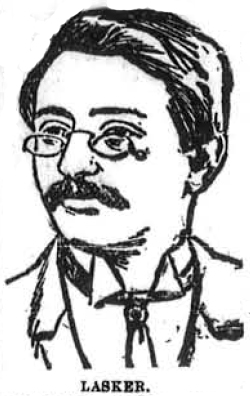
Buckley on Lasker

Buckley on Lasker

From Birmingham Weekly Mercury, August 15, 1896 [Robert John Buckley].

The Chess Champion

Lasker has come out first, an easy first, in the Nuremberg Tourney [Nuremberg 1896: 1. Lasker 13½/18, 2. Maroczy 12½, 3.-4. Tarrasch & Pillsbury 12. 19 players. Ed.], which, in the opinion of many experts, ranks as the strongest Tourney played up to date. Nobody is much surprised, but only four years and a half ago the case was different. At that early period the “Mercury” declared for Lasker, and nailed its colours to the mast. It is easy to prophesy after the event, and Chess Editors innumerable now swear by Lasker. But at one time we were alone, in our belief in his powers; and not only alone, but derided for our faith. In our column of April 9, 1892, we wrote as follows:-

The Berliner is cool, and seems to possess the clear-eyed perceptivity which surveys the board from China to Peru, taking in the situation at a glance. His mastery of the secrets of the chess-board is wonderful. We spent an hour or two with him at the Divan, and his solution of end-games, his manipulation of the pieces, and his command of the board were such as to surprise us very much.

The British masters know not what to do with Lasker, who at all points of the game is armed as with triple steel. They have tried close games, open games, waiting games, ancient style, modern style, irregular openings, hackneyed openings, in vain. They have tried to out-manoeuvre him with Daedalian complications, to beat him in the opening, the middle game, and the end. And whatever style of chess he is actually playing you are apt to think his strongest point.

He is as ingenious as Bird, as subtle as Gunsberg, as original as Steinitz, as brilliant as Tschigorin, as solid and tenacious as Mason, as scientific as half-a-dozen masters rolled into one. In future he must be classed with Steinitz, Blackburne, Tschigorin, Gunsberg, and Weiss.

The only question as to Lasker’s powers relates to physique. He is of slight and delicate appearance, and he may not last. Chess matches and tourneys are a severe test of vitality. Let him keep in good going order, let him remain sound in wind and limb, and we will back him to win the championship of the world.

At this time Lasker had done nothing in particular to justify what was called the “undue extravagance of estimation” in which we held him. But we had seen him, and weighed him in the balances, and the above extract represented our opinion.

The “Dublin Evening Herald”, in its chess column, edited by a well-known barrister, chess champion of Ireland [J. A. Porterfield Rynd, Ed.], was among those journals which good-humouredly bantered us, and in a sparkling article asked for evidence. What had Lasker done? Where were his immortal games? To these queries we had no answer. Lasker had not yet done much, his immortal games were yet to come, and herein, we think, lies the merit of our prediction.

When Lasker won the five-master Tourney [London 1892: 1. Lasker 6½/8, 2. Blackburne 6, 3. Mason 4, 4. Gunsberg 2½, 5. Bird 1. Ed.], and was about to play a match with Blackburne, we wrote (May 21, 1892):-

Lasker is no mere wood-shifter. He is indeed an opponent not to be lightly tackled. His science is complete and up to date, he is wary where caution is needed, bold when boldness pays, tenacious to a heart-breaking degree, possesses undoubted genius, is cool, courageous, ambitious, determined, has individuality of style, combines all that is best of the old and new schools with the endurance and rapid recuperation of four and twenty years.

He may have a weak spot. Blackburne may know where it is. We hope he will find it. But we have inspected Lasker, watched him for days together, weighed him in the balances, and failed to find him in the balances, and failed to find him wanting anywhere.

From this it will be seen that we stuck to our opinion, and that we were justified by events. Lasker beat Blackburne easily, the British champion failing to win a single game throughout the match. Then came the match with Steinitz. That we backed Lasker to win is a matter of public notoriety. Steinitz noticed our prediction, and pleasantly mentioned it to us during the Hastings Tourney [1895. Ed.], in which contest Lasker, in our judgment, fell short of first place only by reason of the ill-health resulting from a recent and malignant attack of typhoid fever. Lasker is Champion of the World, and that, as we have shown, was predicted in the “Mercury” more than four years ago.

Now comes the question, who is to wrest the glory from him – Tarrasch, Pillsbury, Steinitz? We do not think that Tarrasch would have any chance in a match with Lasker. For Tarrasch could only draw a match with Tschigorin, who is a baby to Steinitz, who, up to the present, has not been able to hold his own with Lasker.

Pillsbury is the only living player who would make a great fight with the Champion, and American players should make it worth the while of these two to fight a series of three matches each, seven up, draw nil. The coming match between Lasker and Steinitz we regard as a foregone conclusion. Lasker will win, because Steinitz is 60 years old. We add this to our previous predictions, and will abide by the result. [Lasker defeated Steinitz 12½-4½. Ed.]