Category: Chess

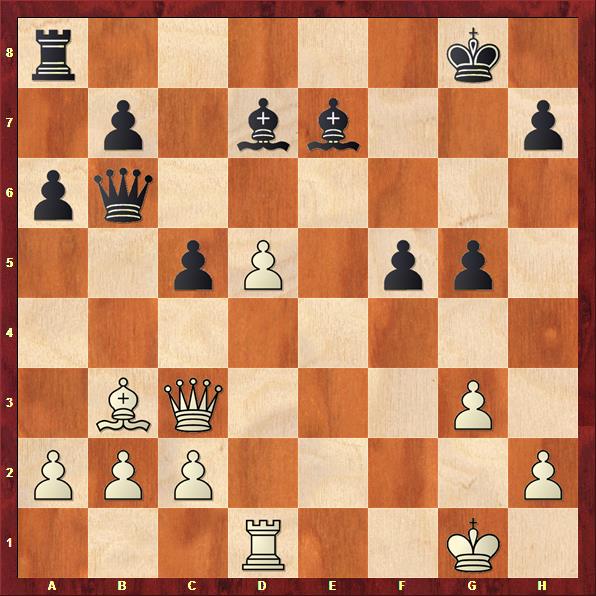
Two discovered checks

Two discovered checks

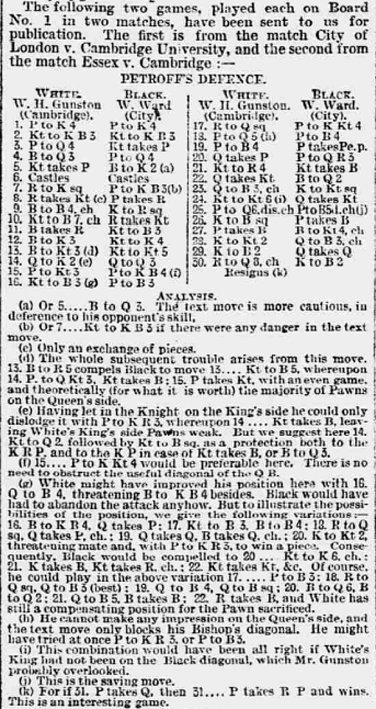
From The London Evening Standard, March 16, 1900:

1900-03-16 London Evening Standard

Gunston – Ward
1. e4 e5 2. Nf3 Nf6 3. d4 Nxe4 4. Bd3 d5 5. Nxe5 Be7 6. O-O O-O 7. Re1 f6 8. Rxe4 dxe4 9. Bc4+ Kh8 10. Nf7+ Rxf7 11. Bxf7 Nc6 12. Be3 Ne5 13. Bb3 Ng4 14. Qe2 Qd6 15. g3 f5 16. Nc3 c6 17. Rd1 g5 18. d5 c5 19. f4 exf3 20. Qxf3 a6 21. Na4 Nxe3 22. Qxe3 Bd7 23. Qc3+ Kg8 24. Nb6 Qxb6

25. d6+ c4+ 26. Kf1 cxb3 27. dxe7 Bb5+ 28. Kg2 Qc6+ 29. Kf2 Qxc3 30. Rd8+ Kf7 0-1

Notes on Louis Zollner, part 1

Notes on Louis Zollner, part 1

Louis Zollner’s Name and Family

According to this 1860 census his name was Laurits Ludvig Zøllner. His father, Carl Georg Ludvig Zøllner, worked as a butcher, and his mother, Charlotte Steenstrup, was 7 years older than her husband and hailed from Norway. At the time of the census Zollner was 6 years old and had three brothers.

This article from 1987 briefly tells the story of how Carl Georg Ludvig Zøllner started his butcher company:

My great grandfather drove around and sold meat from a horse-drawn carriage. At one point money was so tight he had to sell the horse. His sons helped, and in 1867 he was able to purchase a house and plot for 7000 rigsdaler. Since then the business has been in the family’s possession.

The company no longer exists.

Business and Moving to England

A rich source on Zollner’s life is a 7-page article in Chess, November 1938, pp. 96-102:

Louis Zollner was born near Copenhagen, on April 17th, 1854. The Copenhagen Commercial Academy acknowledged him their most brilliant pupil for years. In 1869 he went into a shipping business in Elsinore. [Helsingør. ed.] (…) he came over in 1875 to take up an important consular post in Manchester.

(…) After four years he went to Newcastle.

(…) He brought live stock from Denmark and subsequently inaugurated an important trade with Iceland, from which country he used to ship fifty to sixty thousand sheep and about four thousand horses each year. A fleet of steamers assisted this trade. He formed the Iceland Co-operative Societies.

Distinctions

More from Chess:

His work has brought him several high distinctions: he is a commander of the Dannebrog, a Grand Knight of the Iceland Falcon, and a knight of the Norwegian Order of Saint Olaf (first degree). Eleven years ago he was received in audience by the King of Denmark, our photograph showing him in the uniform he wore on that occasion.
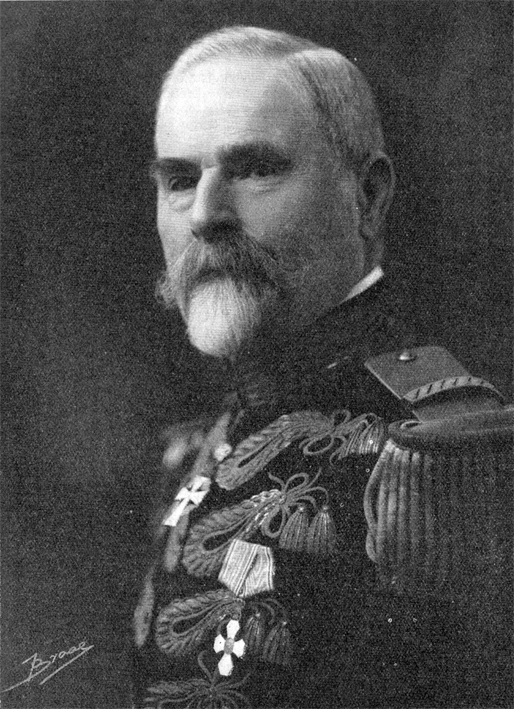
Zollner - Chess 1938-39 p99

The Wager

From Chess:

At forty-three years of age he won a novel wager, racing a yacht from Portsmouth to Newcastle on his bicycle. Yacht and Mr. Zollner left Portsmouth together on a Saturday. He arrived in Newcastle on Monday hours before the yacht … and roads and bicycles (let it not be forgotten) were vastly inferior forty years ago to those of to-day.

The Trophy

Photo from Chess:

Viking Trophy


Part 2

Miss Elaine Saunders

Miss Elaine Saunders

Sevenoaks Chronicle and Kent Advertiser, June 25 1939.

The People, July 23 1939.

1939-07-03 Newcastle Evening Chronicle
Newcastle Evening Chronicle, July 3, 1939.

Henniker Heaton – Elaine Saunders
1. d4 d5 2. c4 e6 3. Nc3 c6 4. e3 Bd6 5. Nf3 f5 6. cxd5 exd5 7. g3 Nf6 8. Bg2 Ne4 9. O-O Nd7 10. Qc2 g5 11. Nd2 g4 12. f3 gxf3 13. Rxf3 Qg5 14. Ne2 Ndf6 15. Nf4 h5 16. Rf1 Nxd2 17. Bxd2 h4 18. Rf3 Ne4 19. Nh3 Qg4 20. Be1 hxg3 21. hxg3 Rxh3 22. Bxh3 Qxf3 23. Qh2 Qxe3+ 24. Bf2 Nxf2 25. Qxf2 Qxg3+ 26. Bg2 Qxf2+ 27. Kxf2 Kf7 28. Re1 Bd7 29. Bh3 Re8 0-1


1939-09-09 Hastings and St Leonards Observer
Hastings & St. Leonards Observer, September 9, 1939.

M. L. Harrison – Elaine Saunders
1. c4 e5 2. Nc3 Nf6 3. b3 Nc6 4. Bb2 Bc5 5. e3 d5 6. Na4 Be7 7. Qc1 Bf5 8. a3 d4 9. Nf3 O-O 10. Be2 Re8 11. O-O d3 12. Bd1 e4 13. Ne1 Bd6 14. h3 Be5 15. Bc3 Qd6 16. Ra2 g5 17. g4 Bd7 18. Ng2 h5 19. f3 exf3 20. Bxf3 hxg4 21. hxg4 Bxg4 22. Bxg4 Nxg4 23. Rf5 Qh6 24. Ra1 Qh2+ 25. Kf1 Qh1# 0-1


1940-03-01 Daily Gazette for Middlesbrough
Daily Gazette for Middlesborough, March 1, 1940.

?? – Elaine Saunders
1. d4 d5 2. Nf3 e6 3. e3 Bd6 4. Bd3 f5 5. c4 c6 6. Nc3 Nf6 7. O-O Ne4 8. Bd2 Nd7 9. Rc1 g5 10. Ne1 g4 11. f3 Bxh2+ 0-1

Unknown Lasker Game

Unknown Lasker Game

Dundee Evening Telegraph, January 10, 1899

Emanuel Lasker – J. R. Henderson
Stirling, January 7, 1899
1. e4 e5 2. d4 exd4 3. Qxd4 Nc6 4. Qe3 Nf6 5. Nc3 d6 6. Bd2 Ng4 7. Qg3 Be7 8. O-O-O O-O 9. h3 Nf6 10. Nf3 Nh5 11. Qh2 f5 12. Bc4+ Kh8 13. g4 fxg4 14. hxg4 Bxg4 15. Be2 Rxf3 16. Rdg1 Rh3 17. Qg2 Rxh1 18. Rxh1 Bxe2 19. Nxe2 Nf6 20. Bc3 Ne5 21. Nf4 Nfg4 22. Kb1 Qe8 23. f3 Nh6 24. Nd5 Qf7 25. Rxh6 gxh6 26. f4 Rf8 27. Nxe7 Qxe7 28. fxe5 dxe5 ‘There were fully 30 moves after this before Herr Lasker resigned.’

The game is not in The Collected Games of Emanuel Lasker by Ken Whyld, but he does mention a simultaneous exhibition in Stirling in January 1899. Lasker played 25 games, won 24 and lost 1.

A Rare Photo of Wenman

A Rare Photo of Wenman

Francis Percival Wenman (left) opposite William Gibson at the Scottish championship 1913-14 in Dundee. From Daily Record and Mail, January 3, 1914.
From The Courier, January 2, 1914

Wenman-Gibson
1. e4 e5 2. Nf3 Nc6 3. Bb5 a6 4. Ba4 Nf6 5. O-O Be7 6. d3 d6 7. c4 O-O 8. h3 h6 9. Nc3 Nh7 10. Nh2 f5 11. f4 Nd4 12. Ne2 Nxe2+ 13. Qxe2 fxe4 14. Qxe4 Nf6 15. Qg6 Kh8 16. Rf3 Ne8 17. fxe5 Rxf3 18. Nxf3 b5 19. Bc2 dxe5 20. d4 e4 21. Bxe4 Nf6 22. Bxa8 Be6 23. Be4 Bg8 24. Bb1 Qd6 25. Qf5 bxc4 26. Qf4 Qe6 27. Ne5 g5 28. Qf5 Qd6 29. Ng6+ Kg7 30. Qe5 Qxe5 31. Nxe5 resigns.

The photo doesn’t seem to match the game. The colour of the pieces can be deceiving, but Wenman never played his bishop to g5. But if we flip the photo, then a Ruy Lopez suddenly appears…

Icelandic Chess Set

Icelandic Chess Set

I found this beautiful chess set during a visit to a farm museum in north eastern Iceland, near Vopnafjordur. It was hand-carved by the farmer himself probably around 1900.

Tartakower – Austrian Volunteer

Tartakower – Austrian Volunteer

Prager Tagblatt, August 23, 1914:

Translation:

Chess Master Tartakower – Austrian Volunteer

Revenge for Mother and Sister

Dr. Tartakower, famous chess master and native Russian, joined the Austrian-Hungarian army to fight against the Russians. When Dr. Tartakower appeared before the military authorities and asked to be enlisted, he was initially dismissed. The chess master, whose name is known and famous for numerous succesful chess tournaments, was visibly devastated by this decision and repeated his request in such a forceful way that he was asked for a reason for his plea. Dr. Tartakower said that only the thirst for revenge was driving him to go against Russia. During a pogrom the so-called Russian people threw his unfortunate mother out of a window so that she fell to her death with a crushed skull. His sister had her eyes gouged out.

“If my wish is fulfilled,” Dr. Tartakower ended his account with tears in his eyes, “and if I only kill one single Russian before I die, I would be the happiest man.”

This shocking statement indeed led to the doctor and famous chess master joining as an ordinary foot soldier.